
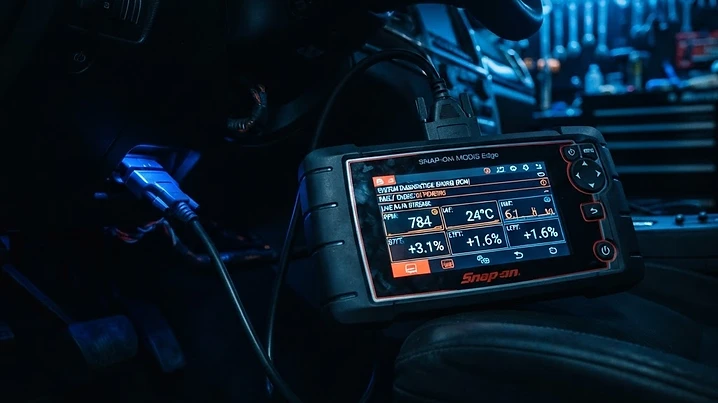
The other day, a customer arrived driving a diesel crossover. The complaint was simple: the car "won't go," the dashboard is lit up like a Christmas tree with warning lights, and fuel consumption has shot up as if he were hauling a trunk full of bricks. We plug in the scanner and see fault codes related to the SCR system and the NOx sensor. For the engine, this sensor is like an environmental inspector's exhaust analyzer: it constantly monitors how much harmful nitrogen oxide is flying out of the tailpipe and tells the control unit how much AdBlue to inject for neutralization. If the sensor goes "blind," the electronics no longer understand how to properly prepare the air-fuel mixture and put the engine into limp mode to keep from polluting the air. ## Symptoms and Causes of Failure Most often, an owner notices a problem when the Check Engine light or an "Emission Control System" message turns on. The car starts losing power, and fuel consumption increases because the engine control unit plays it safe and alters the injection strategy. Why does the sensor fail? Inside, it has complex ceramic elements coated with precious metals. It sits in the hottest part of the exhaust system. Over time, the ceramic cracks from temperature fluctuations, gets clogged with soot, or simply reaches the end of its service life. Sometimes the issue lies not in the sensor itself, but in the wiring or connectors that corrode from moisture and road salt. ## Diagnostics and Common Mistakes The biggest mistake car owners make is trying to "clean" the sensor or pour additives into the tank. That does not work. A NOx sensor is a high-precision instrument, not just a piece of metal. If it produces incorrect data, no amount of flushing will restore its factory accuracy. During diagnostics, we first check circuit integrity and power supply, and then evaluate live parameters via computer diagnostics. If the sensor is "stuck" on one value or outputs nonsense, it must be replaced or disabled. ## Repair or Deletion? Replacing it with a new sensor is not cheap, as it truly contains precious metals inside. If you plan to drive the car for a long time and frequently travel to EU countries with strict vehicle inspections, replace it with an OEM unit. However, if your budget is tight or the car is driven where emissions regulations are not as strict, we offer NOx sensor delete at the software level. This allows you to permanently forget about errors and limp mode without any loss of performance. In some cases, if the issue is systemic, ECU repair or reprogramming may be required. ## Practical Takeaway Do not ignore emissions-related trouble codes. Limp mode is not just a light on the dashboard; it causes increased stress on the pistons and the particulate filter. If the scanner shows a faulty NOx sensor, do not try to "cure" it with home remedies—come in for a professional checkup to find out whether the component can be saved or if it is time to code it out of the system.
Read also
Проверка реального пробега при покупке автомобиля: честно о том, что возможно
Скрученный пробег — одна из самых частых проблем при покупке авто с рук. Рассказываем, как проверяется реальный пробег по электронике, почему не на всех марках это просто и что стоит проверить до оплаты.
Video: A look at our work at AUTOLAB
We filmed a raw, unedited look at a day in the AUTOLAB workshop, showing exactly how our diagnostics and ECU tuning processes happen behind the scenes.
Car won't start: the story of a dead ECU
A client brought in a car that suddenly stopped responding to the key. We explain why sometimes the problem isn't mechanical, but rather in the car's brain.