
A modern diesel vehicle often resembles a complex medical system: as long as everything runs smoothly, the engine delights with robust torque and great fuel economy. But as soon as the yellow glow plug coil or check engine light pops up on the dashboard, mysterious acronyms appear: DPF, EGR, AdBlue, regeneration. Let's break down without confusing jargon what these components are, why they exist, and why they cause car owners the most headaches.
The Holy Trinity of Diesel Emissions: Roles and Responsibilities
To keep diesel exhaust clear and environmentally friendly, automotive engineers split the cleaning process into three main stages:
- EGR (Exhaust Gas Recirculation valve). This valve redirects a portion of the exhaust gases back into the intake manifold. Think of it like home heat recovery: by mixing spent gases with fresh intake air, the system lowers peak combustion temperatures inside the cylinders, which significantly reduces the formation of toxic nitrogen oxides (NOx).
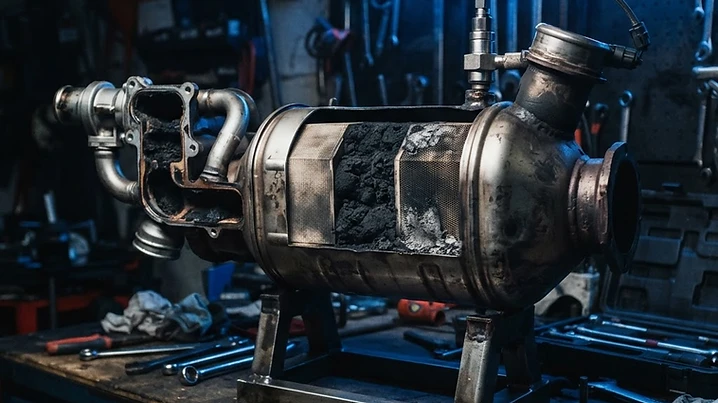
- DPF (Diesel Particulate Filter). This is a physical trap for unburnt microparticles of fuel, better known as black soot. Picture a ceramic vacuum cleaner bag with microscopic pores: exhaust gases flow through freely, while soot particles get trapped inside.
- AdBlue (SCR System). A chemistry lab right inside the exhaust pipe. A special 32.5% purified urea solution is injected directly upstream of the SCR catalyst. Reacting chemically with the hot exhaust gases, AdBlue breaks down harmful nitrogen oxides into harmless elemental nitrogen and standard water vapor.
Regeneration: How the Vacuum Cleans Itself
A particulate filter is not bottomless. To prevent it from clogging completely every few thousand kilometers, automakers engineered an automated self-cleaning cycle: regeneration.
When the engine control unit (ECU) detects via differential pressure sensors that exhaust backpressure is getting too high, it initiates a burn-off cycle. The ECU injects an extra dose of diesel fuel late during the exhaust stroke. This unburnt fuel reaches the exhaust system and ignites, heating the filter up to 600°C (over 1100°F). The trapped soot literally burns away, turning into carbon dioxide and a minute amount of non-combustible ash. During this process, you might notice your vehicle humming slightly louder, idling higher, or activating rear window and seat heaters to add an electrical load on the engine.
Why Systems Fail: The Number One Enemy of Emissions Gear
All emissions components are built for highway driving, where the engine operates steadily under load at high operating temperatures. Problems start quickly with repetitive short city trips:
- Underheating and Stop-and-Go Traffic. If your drive is only 10 to 15 minutes between home and work, the exhaust simply never gets hot enough. DPF regeneration either fails to trigger or gets aborted halfway through. Frequent interrupted regenerations cause raw unburnt diesel to seep past piston rings into the oil sump, gradually diluting your engine oil.
- EGR Valve Clogging. Oily crankcase ventilation vapors mix with dry soot from the exhaust, creating a thick, sticky sludge inside the intake. The valve eventually seizes in an open or closed position, choking the engine, causing a loss of power, and producing even more smoke. In cases of irreversible hardware failure, owners often turn to comprehensive software emissions delete solutions.
- AdBlue Gremlins. The fluid can crystallize around the injector tip if there is a leak, freeze during harsh winters below -11°C (12°F), or fail due to tank heater and NOx sensor malfunctions. Once an SCR fault occurs, the dashboard often starts an engine-start countdown timer: after a set mileage, the ECU will lock out the starter completely.
What Owners Should Do: Diagnostics Over Guesswork
If warning lights illuminate, engine power drops, or the vehicle enters limp-home mode ("won't go past 80 km/h"), do not waste money blindly replacing sensors or hoping highway driving will magically solve the issue.
A clogged particulate filter is almost always a symptom rather than the root cause. It gets choked because of a leaking fuel injector, a split intercooler hose, or a stuck EGR valve. Proper computer diagnostics allows technicians to evaluate the actual calculated soot and ash mass, monitor real-time backpressure, test the AdBlue dosing injector, and trigger a forced service regeneration via scan tool if safe to do so. Have your emissions system parameters checked during routine maintenance, let the car "stretch its legs" on the open highway periodically, and your diesel will reward you with reliable performance.
Read also
DPF Removal: Why It's Done and How to Do It Right
Why the diesel particulate filter gets clogged, what risks it poses, and how software DPF delete is done properly.
What Is Electronic System Adaptation and Why Repair Isn't Done Without It
After replacing a sensor or component, a car sometimes behaves strangely. We explain in plain English what the adaptation procedure is and why the ECU cannot read the mechanic's mind.