
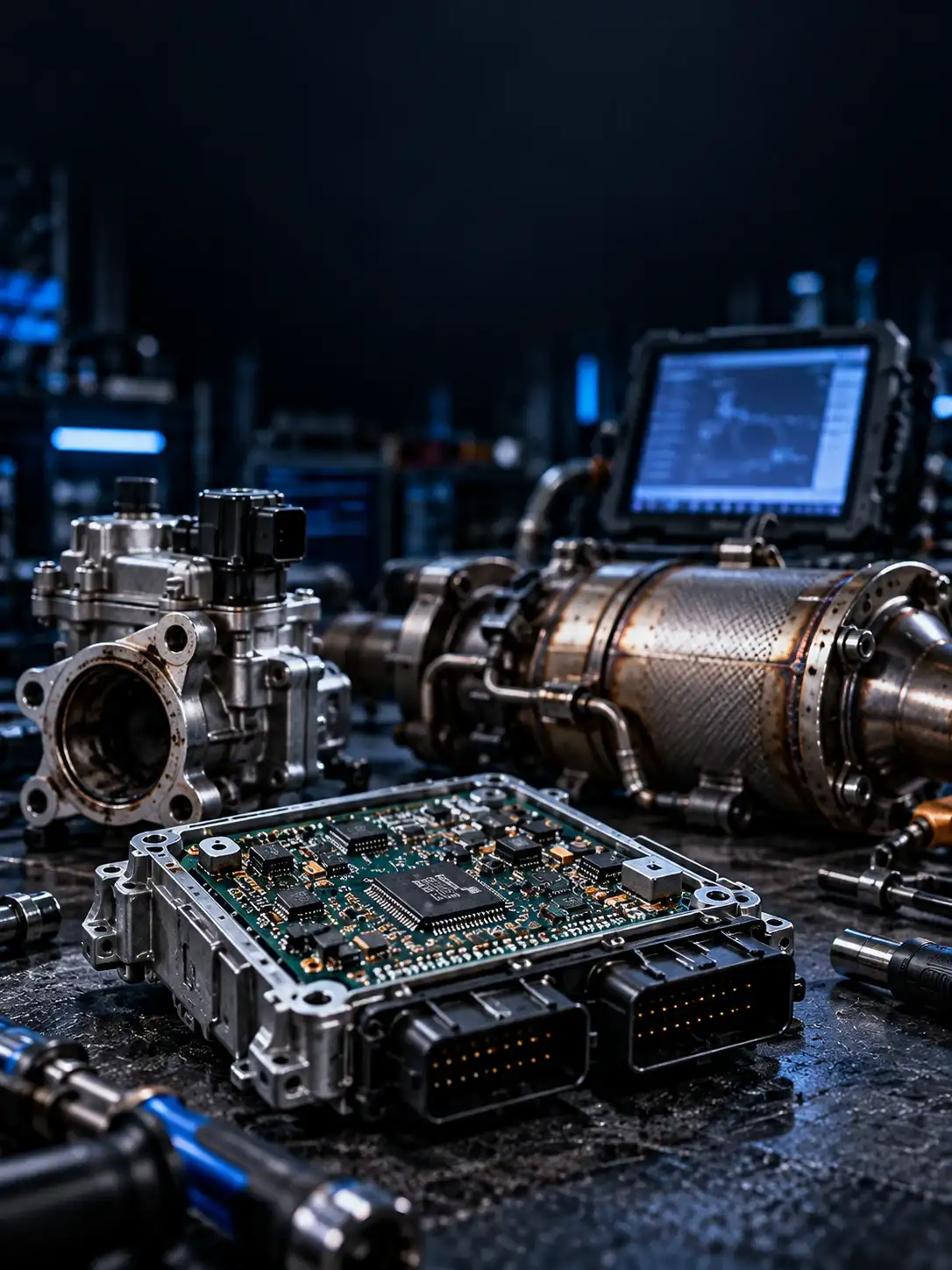
DPF, EGR & AdBlue (SCR) diagnostics and software deactivation
DPF, EGR & AdBlue (SCR) Diagnostics and Software Deactivation
Is your Check Engine light on, power reduced or an AdBlue warning showing? We check the DPF, EGR valve and AdBlue/SCR system, explain the cause and repair options, and assess software deactivation only where applicable and permitted. Work is agreed after diagnosis.
Thematic AI illustration
- 01
Find out what is happening
We ask when the warning appeared and how the car is behaving. We check the available faults and readings from the DPF, EGR and AdBlue systems. A fault code is a clue, not proof that a particular part needs replacing.
Show example
EXAMPLES OF FAULTS A SCANNER MAY SHOW- P2463DPF — possible filter restrictionEXAMPLE
- P0401EGR — insufficient exhaust gas flowEXAMPLE
- P204FAdBlue — possible system faultEXAMPLE
- P0420Catalyst — lower than expected efficiencyEXAMPLE
DEMONSTRATION ONLY: NOT A LIVE DIAGNOSTIC RESULT
EXAMPLES OF FAULTS A SCANNER MAY SHOW- P2463DPF — possible filter restrictionEXAMPLE
- P0401EGR — insufficient exhaust gas flowEXAMPLE
- P204FAdBlue — possible system faultEXAMPLE
- P0420Catalyst — lower than expected efficiencyEXAMPLE
DEMONSTRATION ONLY: NOT A LIVE DIAGNOSTIC RESULT
- 02
Check the electronic controls
If the first inspection is not enough, we check the signals from sensors and how the engine control unit operates the system. If needed, we identify the software version and whether suitable service procedures are available.
Show example
- 03
Explain the cause and your options
We discuss the findings and suitable repairs, such as fixing wiring, a sensor or a valve, or another permitted procedure. We agree what to do and the cost first rather than simply hiding a warning.
Show example
EXAMPLE: WHAT NEEDS CHECKINGEGR valveTO CHECKDPF particulate filterTO CHECKAdBlue systemTO CHECKCatalytic converterTO CHECKOxygen sensorTO CHECKEXAMPLE: WHAT NEEDS CHECKINGEGR valveTO CHECKDPF particulate filterTO CHECKAdBlue systemTO CHECKCatalytic converterTO CHECKOxygen sensorTO CHECK - 04
Carry out the agreed work
After diagnosis, we explain which repair is needed. If software deactivation of a specific system is technically feasible and permitted, we discuss that option separately. Software changes and any mechanical work are agreed in advance.
Show example
EXAMPLE SYSTEM CHECK$ SYSTEM CHECK — EXAMPLE> SENSORS ........ CHECK> WIRING ......... CHECK> REPAIR WORK .... BASED ON FINDINGS$ demonstration, not a vehicle reportroot@diag-lab:~$ ▌EXAMPLE SYSTEM CHECK$ SYSTEM CHECK — EXAMPLE> SENSORS ........ CHECK> WIRING ......... CHECK> REPAIR WORK .... BASED ON FINDINGS$ demonstration, not a vehicle reportroot@diag-lab:~$ ▌ - 05
Check the car after repair
We check the available warnings and system readings again. We may also carry out a road test where safe and necessary. We judge the result by how the car is working, not just whether the light goes out.
Show example
EXAMPLE CHECK AFTER REPAIR// READY TO RUN
EXAMPLE CHECK AFTER REPAIR// READY TO RUN
DPF — diesel particulate filter
Captures soot from diesel exhaust and periodically cleans itself under suitable driving conditions. A blocked filter or faulty sensor can trigger a warning.
EGR — exhaust gas recirculation
Returns some exhaust gas to the engine to reduce emissions. Dirt or a mechanical or electrical fault can affect how the engine runs.
SCR / AdBlue — exhaust treatment
Uses AdBlue fluid to reduce harmful emissions. Problems can involve the pump, sensors or fluid delivery.
The particulate filter cleans itself too often
If filter cleaning starts too frequently or does not finish, we check the filter condition and its sensors.
EGR warning or rough engine running
The valve may be dirty, sticking or receiving the wrong signal. We find out what is causing the problem.
AdBlue warning or a no-start countdown
A sensor, pump, fluid dosing or wiring fault may be responsible. We check the likely cause before recommending a repair.
Check Engine light and loss of power
Reduced power has many possible causes. We check which system has actually reported a fault.
You do not want to buy expensive parts at random
We check sensors, wiring and system operation before recommending an expensive replacement.
A check after earlier repairs
We assess whether the system is now working properly and whether the warning has returned.
Software that does not fit the car
POSSIBLE RISK: Installing the wrong version can make the control unit behave incorrectly. Compatibility needs checking first.
Faking a sensor signal instead of repair
POSSIBLE RISK: A false signal can hide the fault without fixing the actual cause.
Just clearing the fault message
POSSIBLE RISK: If the fault remains, the warning may come back. The system itself needs checking.
The same software for every car
POSSIBLE RISK: Even similar cars can have different control units and software. Unsuitable changes may affect the engine.
No copy of the original data
POSSIBLE RISK: Where supported, we save accessible original data before programming. A complete backup is not possible for every unit.
No check after the work
POSSIBLE RISK: Without a final inspection, remaining faults may be missed. We check the result separately.
// We start by identifying the cause and agreeing on the next steps. Interactive examples on this page are not actual vehicle diagnostic results.
The systems work together
An unsuitable change to one system can affect the engine or other parts.
Every car has its own settings
Similar control units may have different software. We check compatibility before working on them.
Programming needs stable power
A power or communication interruption can damage the control unit software. We prepare appropriate conditions before writing.
The problem may be a part or wiring
A sensor, valve, filter or poor connection can cause similar symptoms. We investigate before choosing a repair.
Checks are needed after the work
We review warnings and readings, and carry out a road test when safe and appropriate.
Restoring earlier software is not always possible
We save available original data where supported, but recovery depends on the unit and the software available.
// SUMMARY: We investigate the cause, explain the options and agree the work first. After repair, we check the result. The available procedures depend on the vehicle.
// Changes to emissions-control systems may be restricted or prohibited for vehicles used on public roads. Any proposed work must meet applicable technical and legal requirements.
Other AUTOLAB services
Ready to start the job?
Describe the problem in the contact form — we reply within a day.