
Engine tuning
Chip tuning
Want your car to accelerate with more confidence and respond better when you press the accelerator? Chip tuning changes the software that controls the engine. We first check the car’s condition and explain what is possible for your particular model.
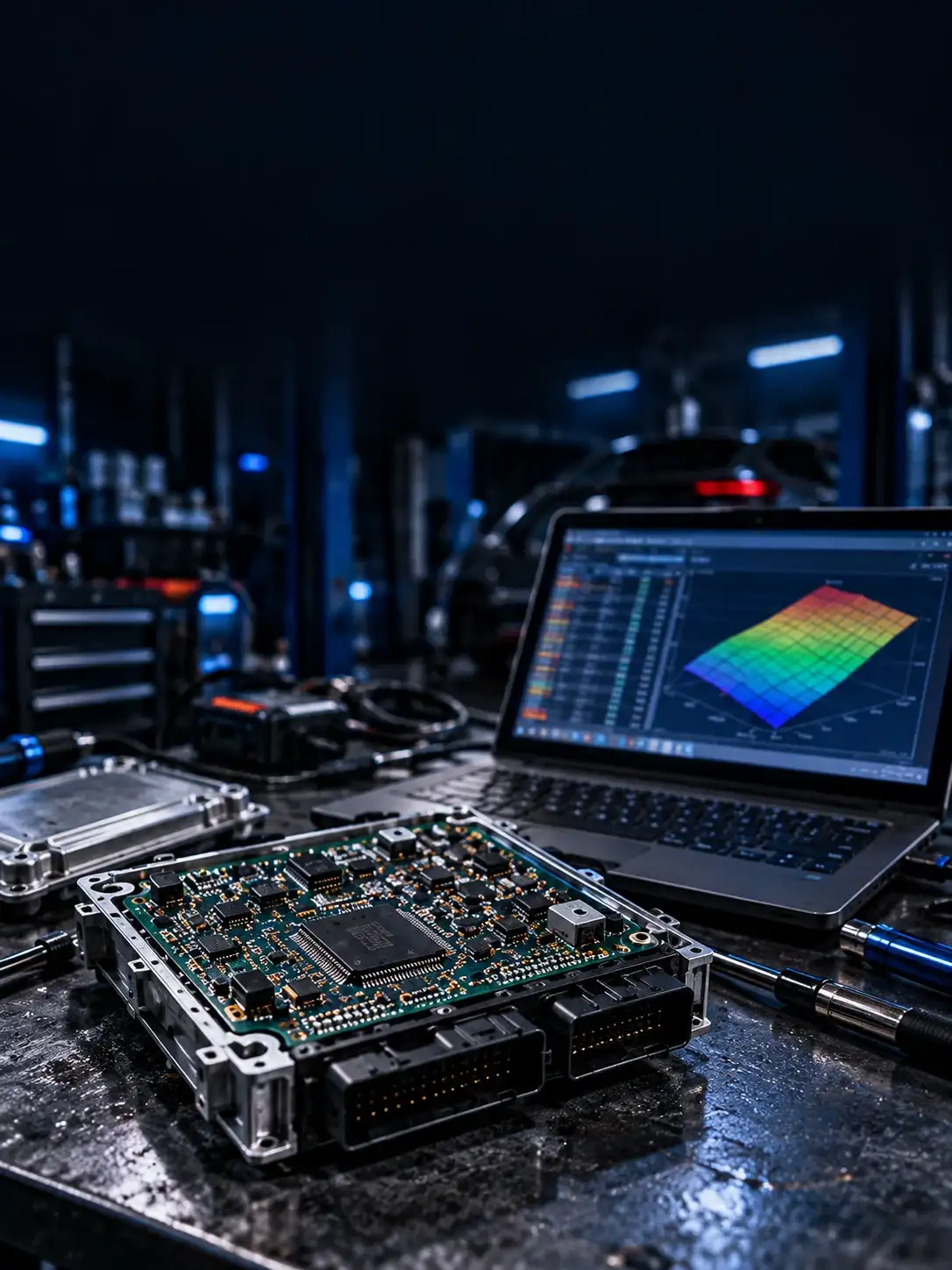
Thematic AI illustration
- 01
Listen and inspect the car
Tell us what bothers you: acceleration, throttle response or overtaking. We check the engine and fault codes. If there is a fault, we investigate it first.
Show example
vehicle --scan$ CHECK · DEMONSTRATION> ENGINE CONDITION ... TO INSPECT> FAULT CODES ... TO CHECK> NEXT STEPS ... DEPEND ON CAR$ example, not a real vehicle scanroot@diag-lab:~$ ▌vehicle --scan$ CHECK · DEMONSTRATION> ENGINE CONDITION ... TO INSPECT> FAULT CODES ... TO CHECK> NEXT STEPS ... DEPEND ON CAR$ example, not a real vehicle scanroot@diag-lab:~$ ▌ - 02
Check what is possible
We identify the vehicle and control unit, then check whether programming is supported and which options make sense.
Show example
- 03
Choose suitable settings
We consider the engine and gearbox. We do not apply the same file to every vehicle.
Show example
MAP_EDITOR — TORQUE_LIMITER.MAPINTERACTIVE ILLUSTRATION · NOT REAL ECU MAPS OR PROGRAMMING
MAP_EDITOR — TORQUE_LIMITER.MAPINTERACTIVE ILLUSTRATION · NOT REAL ECU MAPS OR PROGRAMMING
- 04
Program the control unit
If everything is suitable, we program the changes using professional equipment. We save original data where possible.
Show example
flash --example (demo only)// READY TO RUN
flash --example (demo only)// READY TO RUN
- 05
Check the result
After programming, we check fault codes and engine operation. We may also take the car for a test drive.
Show example
DYNO_LOG — POWER / TORQUE- hp stock
- hp tuned
- Nm stock
- Nm tuned
ILLUSTRATIVE GRAPH ONLY · NOT A DYNO TEST OR A PERFORMANCE PROMISE
DYNO_LOG — POWER / TORQUEILLUSTRATIVE GRAPH ONLY · NOT A DYNO TEST OR A PERFORMANCE PROMISE
Not enough pull when overtaking
On some engines, tuning may improve acceleration. We rule out faults before making changes.
The car feels slow to respond
Throttle response can sometimes be adjusted. If a fault causes the delay, it needs repair.
The car struggles when loaded
We assess whether improving pull under load is possible without unnecessary risk to the engine or gearbox.
I would like to use less fuel
Fuel use depends on journeys and driving style. Real savings need a fair comparison.
Engine parts have been changed
We check whether the software needs to match the modified components.
I want the factory settings back
We check whether the original software is available and can be written safely.
“It lacks power on the motorway”
ACCELERATIONCUSTOMER QUESTION
NEEDS MORE PULL
WHAT WE CHECK
ENGINE CONDITION
We inspect the engine first. If it is healthy and the ECU is supported, we can discuss suitable tuning options.
“I press the pedal and nothing happens straight away”
THROTTLE RESPONSECUSTOMER QUESTION
SLOW RESPONSE
WHAT WE CHECK
CAUSE OF THE DELAY
The cause might be the software or a fault. We identify it before changing anything.
“I have changed parts and want it set up properly”
AFTER MODIFICATIONSCUSTOMER QUESTION
PARTS HAVE CHANGED
WHAT WE CHECK
COMPATIBILITY
We check the modifications and whether the engine software should be adjusted.
“I want the original software back”
FACTORY SOFTWARECUSTOMER QUESTION
WANT PREVIOUS FILE
WHAT WE CHECK
AVAILABLE SOFTWARE
We check the ECU and available software. Returning to an earlier version is not always straightforward.
// COMMON CUSTOMER QUESTIONS, NOT ACTUAL JOB RESULTS
ECU compatibility
We check whether our equipment supports your particular control unit.
Engine condition
An existing fault may need repair before tuning.
What we plan to change
We explain the options and their limits before programming.
Checks after programming
We check how the car behaves after the software changes.
What we discuss before work
- Chip tuning will not fix mechanical engine faults.
- Unsuitable settings can increase stress on the engine and gearbox.
- Changing ECU software may affect a manufacturer’s warranty.
- Returning to factory software is not possible on every ECU.
// What we can offer
Stage 1
Engine tuning without replacing parts. On suitable cars, it may improve acceleration and throttle response.
Stage 2
For cars with changes to engine components. We first check what has been modified and what software adjustments are appropriate.
Fuel consumption
We discuss how you drive and use the car. Savings depend on route, load and driving habits, so they cannot be promised in advance.
Factory software
Want to return to the original settings? We check whether a suitable factory software version is available for your ECU.
Fix faults before tuning
New software will not solve the underlying cause of a poorly running engine.
Not all engines respond the same way
An adjustment suitable for one engine may not suit another.
The gearbox matters too
More pulling power also puts load on the clutch or automatic transmission.
No universal power promises
Power and fuel use need to be assessed on the actual car.
Warranty may be affected
The impact depends on the manufacturer’s terms and applicable law.
Returning to stock is not always possible
It depends on the ECU and available factory software.
// SUMMARY: Results depend on your engine and its condition. Specific figures need appropriate checks rather than guesses.
Other AUTOLAB services
Ready to start the job?
Describe the problem in the contact form — we reply within a day.