
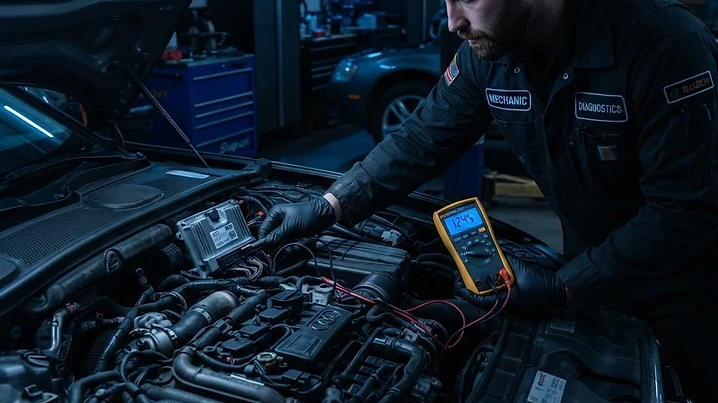
A client arrived on a tow truck. It is a classic situation: they parked the car in the evening, and in the morning—total silence. The starter won't turn, the dashboard is lit up like a Christmas tree, and there is no communication with the engine control unit (ECU). The owner had already replaced the battery and checked all the fuses, but with zero results. ## Symptoms and initial inspection First, we plug in a scanner. The diagnostic port 'sees' the body electronics, but the engine control unit doesn't respond. It is like trying to call someone whose phone is switched off or broken. The problem is clearly in the power supply to the unit itself or its internal health. We perform a computer diagnostics check to rule out simple wiring breaks. ## Finding the cause We start by checking the ECU power supply. The multimeter shows that voltage is reaching the pins, but there is no ground. We follow the wiring harness and find a rotted contact in the connector, which had turned to dust over the years due to moisture ingress. Oxidation is the main enemy of electronics. Green corrosion formed inside the connector, preventing the signal from passing through. This is like a clog in a water pipe: there is water (current), but it doesn't reach the tap. ## Solving the problem Simply cleaning the contacts is not always enough. If the corrosion has managed to reach the circuit board inside the unit itself, it needs to be opened. In this case, we were lucky: the damage was only on the connector. We restored the integrity of the circuit, soldered the contacts, and protected them with a special anti-moisture compound. After that, the unit 'came back to life,' established communication, and the car started immediately. If the internal board had burned out, we would have had to perform ECU repair or look for a replacement and then program it to the car. ## Common mistakes Owners often try to 'revive' a car by applying direct power to sensors or replacing units at random. This is a direct path to short circuits and burning out expensive components. Diagnostics is not guessing; it is a systematic search. You shouldn't mess with electronics without a wiring diagram and an understanding of where each wire goes. ## Practical takeaway If your car suddenly stops starting and the scanner cannot see the engine, don't rush to buy a new unit. In 70% of cases, the problem lies in the wiring, a poor ground connection, or oxidized connectors. If it comes down to a replacement, remember that a modern unit cannot simply be swapped from another car—it will require ECU cloning to transfer the immobilizer data.
Read also
Проверка реального пробега при покупке автомобиля: честно о том, что возможно
Скрученный пробег — одна из самых частых проблем при покупке авто с рук. Рассказываем, как проверяется реальный пробег по электронике, почему не на всех марках это просто и что стоит проверить до оплаты.
Video: A look at our work at AUTOLAB
We filmed a raw, unedited look at a day in the AUTOLAB workshop, showing exactly how our diagnostics and ECU tuning processes happen behind the scenes.
Oxygen sensor: why your car is guzzling fuel and losing power
We break down a case where an oxygen sensor error leads to extra expenses and explain why replacing the part doesn't always solve the problem.