
A New Era of Data Transfer
In the past, car diagnostics felt like talking on a landline phone: slow, but straightforward. Protocols like the CAN bus handled simple commands well, but modern systems with cameras, radars, and multimedia require massive bandwidth. Now, Automotive Ethernet has taken root in vehicles. If data used to flow through the car like a narrow country road, Ethernet is a high-speed highway where information is transmitted in packets, just like in a home computer or server.
What Has Changed for the Owner
The main difference is the DoIP (Diagnostics over Internet Protocol). Previously, a scanner simply "listened" to the bus; now, it must "negotiate" with the control unit according to the rules of IP networking. Flashing modules, which used to take half an hour, now happens in a couple of minutes. However, this requires the service center to have not only powerful equipment but also specific knowledge of network protocols. If your scanner does not support DoIP, it simply won't see the car, even if it is physically connected to the OBD-II port.
Diagnostics as Network Maintenance
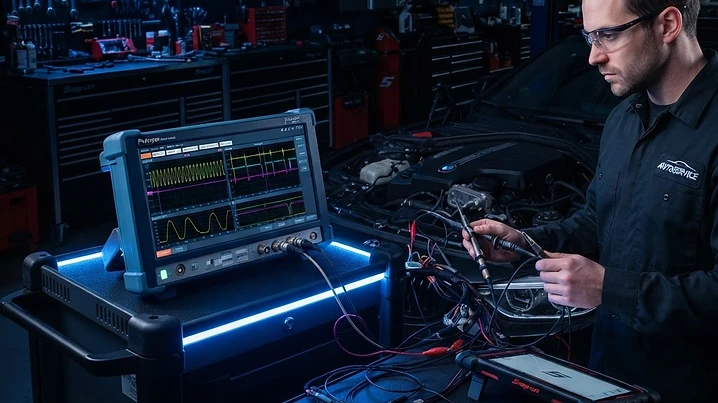
When we connect to a modern vehicle, we check not only for error codes but also for the integrity of the network connection. Imagine that diagnostics is like finding a broken internet cable in your apartment: you need to check the wire itself, the settings of the "router" (gateway), and the correctness of packet transmission. We use next-generation computer diagnostics to monitor these data streams. A standard "code reader" is useless here, as it cannot work with packet-based data transmission and does not understand the structure of a service-oriented architecture.
Common Challenges
A frequent problem is DIY attempts or the use of cheap adapters that flood the network with junk requests. In an Ethernet architecture, this leads to conflicts that can cause control units to go into limp mode or stop communicating altogether. Also, when replacing modules, it is now critically important not just to install the "hardware," but to correctly register it in the network configuration, which requires professional ECU programming.
Practical Conclusion
Cars have become full-fledged IT systems on wheels. If your car was manufactured in the last 3–5 years, a standard garage scanner might be powerless. In case of any electrical oddities, contact specialists who work with current data transmission protocols to avoid turning a minor glitch into an expensive electronics repair.
Read also
Проверка реального пробега при покупке автомобиля: честно о том, что возможно
Скрученный пробег — одна из самых частых проблем при покупке авто с рук. Рассказываем, как проверяется реальный пробег по электронике, почему не на всех марках это просто и что стоит проверить до оплаты.
Video: A look at our work at AUTOLAB
We filmed a raw, unedited look at a day in the AUTOLAB workshop, showing exactly how our diagnostics and ECU tuning processes happen behind the scenes.
Car won't start: the story of a dead ECU
A client brought in a car that suddenly stopped responding to the key. We explain why sometimes the problem isn't mechanical, but rather in the car's brain.