
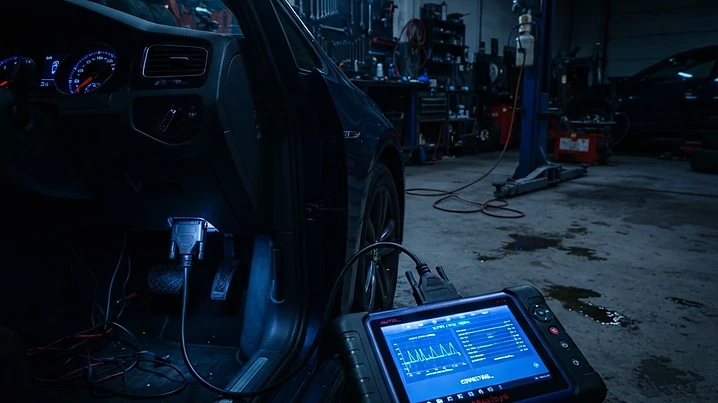
Emission control systems in diesel vehicles are filters and valves designed to make exhaust cleaner. The DPF (Diesel Particulate Filter) catches soot, the EGR (Exhaust Gas Recirculation) valve redirects part of the exhaust gases back into the cylinders to lower combustion temperature, and AdBlue injects urea to neutralize nitrogen oxides. Think of it like a home water filtration system: if the cartridges are clogged, the water stops flowing. It is the same here: when channels get blocked by soot or urea crystals, the engine begins to "choke." ## Symptoms and causes of failure Problems most often start after prolonged city driving. The DPF does not have time to complete its self-cleaning cycle (regeneration) because it requires high engine speeds and highway driving. As a result, the filter becomes completely clogged. The EGR valve suffers from carbon buildup—it simply gets "stuck" in an open or closed position. The situation with AdBlue is more complex: the fluid is sensitive to frost and poor quality, causing pumps to fail and NOx sensors to report errors. If you see a Check Engine light on your dashboard or a message stating that the engine will not start after a certain distance, it is a signal that the engine control system has switched to emergency mode. ## Diagnostics: how we find the culprit We do not replace parts by guessing. First, we perform computer diagnostics to see the actual pressure levels in the exhaust system and the operation of the sensors. An oscilloscope here works like an EKG for a doctor: we look at sensor signals in real time to understand whether the component itself has "died" or if the problem lies in the wiring leading to it. It often happens that the valve itself is not to blame, but rather a corroded connector or a frayed wire. ## Repair mistakes The most common mistake is attempting to "flush" a clogged particulate filter or simply resetting the error with a scanner. This is a temporary fix. If the root cause (e.g., a faulty injector or a malfunctioning temperature sensor) is not resolved, the error will return after 50–100 kilometers. It is also dangerous to ignore AdBlue warnings: when the start counter reaches zero, the car will simply refuse to start, requiring ECU repair or major software intervention. ## Solutions If the component is still salvageable, we perform forced regeneration or cleaning. If its service life is exhausted, there are two paths: replacement with a new original unit or software deactivation. The latter allows you to forget about emission system problems forever, as we adjust the control unit's firmware so it no longer waits for signals from the faulty systems. The practical takeaway: do not wait until your car enters emergency mode. If you notice a loss of power or strange messages on the dashboard, it is better to come in for a check-up immediately, before the fault leads to expensive engine component damage.
Read also
Проверка реального пробега при покупке автомобиля: честно о том, что возможно
Скрученный пробег — одна из самых частых проблем при покупке авто с рук. Рассказываем, как проверяется реальный пробег по электронике, почему не на всех марках это просто и что стоит проверить до оплаты.
Video: A look at our work at AUTOLAB
We filmed a raw, unedited look at a day in the AUTOLAB workshop, showing exactly how our diagnostics and ECU tuning processes happen behind the scenes.
Car won't start: the story of a dead ECU
A client brought in a car that suddenly stopped responding to the key. We explain why sometimes the problem isn't mechanical, but rather in the car's brain.