
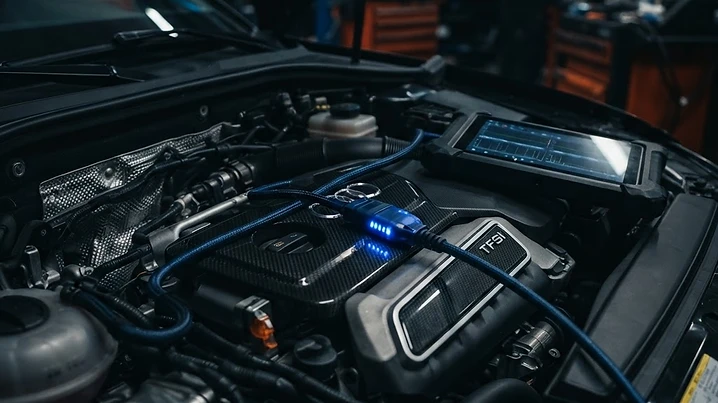
What is an ECU and why does it need a "brain"? The Electronic Control Unit (ECU) is your car's computer. Think of it as an experienced driver sitting inside the vehicle, constantly monitoring hundreds of sensors. It sees how much air enters the cylinders, what the outside temperature is, and how hard you are pressing the gas pedal. Based on this data, it decides how much fuel to inject and when to fire the spark. If you want your car to run like clockwork, computer diagnostics is the first step toward understanding exactly what this computer is "thinking." ## Why adaptation is needed after repairs Many people believe that car parts work on a "plug-and-play" basis. However, electronics don't work that way. For example, you cleaned the throttle body. Previously, it was covered in carbon deposits, and the control unit learned to compensate for this by opening it slightly more. You removed the dirt, but the "brain" continues to send commands based on old memories. As a result, the idle fluctuates and the car behaves strangely. Adaptation is the process of "re-learning" the control unit to the new physical parameters of a component. It’s like being used to wearing heavy boots and then switching to light sneakers: you’ll stumble for the first few steps until your brain gets used to the new weight. ## Immobilizer and keys: When your car doesn't recognize you The immobilizer is a security guard that checks the key's "ID" before allowing the engine to start. If you’ve lost a key or decided to make a duplicate, simply cutting the blade isn't enough. You need to program the chip into the ECU's memory. If the system doesn't see a "familiar" key, it blocks the fuel supply or spark. In such cases, professional work with the immobilizer or key programming is required so the car starts trusting its owner again. ## Oscilloscope: An EKG for your engine When a scanner shows an error but the cause isn't clear, we connect an oscilloscope. This device draws a graph of voltage over time. Imagine visiting a doctor and getting an EKG. Through this "cardiogram," we can see exactly how the crankshaft sensor or a fuel injector is performing in real-time. If the signal is "choppy" or has interference, it means the issue is in the wiring or the sensor itself, even if the computer isn't showing a direct error code. This allows us to find faults without replacing perfectly good parts by trial and error. ## Practical conclusion A modern car is a complex network of interconnected systems. Any intervention, whether it's changing the transmission fluid or cleaning the throttle body, may require software calibration. If your car behaves strangely after a repair, don't rush to replace everything—the system might just need help "getting used to" the new conditions through adaptation.
Read also
Проверка реального пробега при покупке автомобиля: честно о том, что возможно
Скрученный пробег — одна из самых частых проблем при покупке авто с рук. Рассказываем, как проверяется реальный пробег по электронике, почему не на всех марках это просто и что стоит проверить до оплаты.
Video: A look at our work at AUTOLAB
We filmed a raw, unedited look at a day in the AUTOLAB workshop, showing exactly how our diagnostics and ECU tuning processes happen behind the scenes.
Car won't start: the story of a dead ECU
A client brought in a car that suddenly stopped responding to the key. We explain why sometimes the problem isn't mechanical, but rather in the car's brain.