
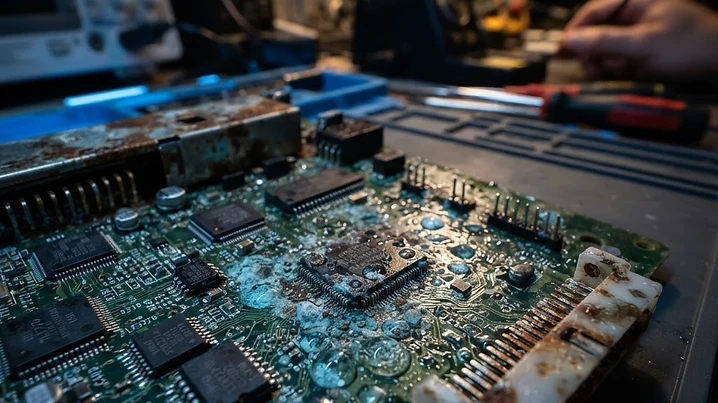
A client came to us with a crossover that simply refused to start after an engine bay wash. The dashboard looked like a Christmas tree full of error messages, the starter would turn, but the engine wouldn't even catch. The owner was already mentally preparing to buy a new control unit, the prices of which are quite steep these days. ## Symptoms and initial inspection When a car behaves erratically and the scanner reports errors for modules that physically cannot fail all at once, we immediately look at the health of the wiring and the modules themselves. In this case, the diagnostic scan showed no communication with the engine ECU. It's as if a human's brain suddenly shut down: the body is there, but there are no commands. Upon opening the control unit housing, we saw the classic picture: traces of oxidation on the board. Moisture had entered through a leaky connector, and the circuits had started to rot. ## Why this happens An Electronic Control Unit is a complex multi-layer board. When water gets inside, it starts conducting current where it shouldn't. This causes short circuits. The oxides that form on the contacts act as insulators or, conversely, create parasitic connections. As a result, signals from sensors become distorted, and the processor simply freezes or goes into protective mode. This often happens due to clogged drain holes under the windshield or poor-quality high-pressure engine bay washing. ## The restoration process Repairing such boards is precise, jeweler-like work. We use a microscope and specialized chemicals to clean off the oxides. If the circuits have rotted away completely, we have to restore them with thin jumpers. After cleaning and soldering, we test the unit on a test bench. If the processor is alive, once the power and data exchange circuits are restored, the unit starts communicating with the car again. In difficult cases, where damage is critical, we offer ECU repair or, if the board has turned into scrap, unit replacement with data cloning. ## Common mistakes The biggest mistake car owners make is trying to "dry out" the unit with a hair dryer or leaving the car in the sun. The moisture may leave, but salts and electrolysis products remain. They continue to destroy the board even in a dry state. It is also dangerous to try and start the car when the unit is already glitching—you could fry the drivers that control the injectors or ignition coils, which would make the repair significantly more expensive. ## Practical takeaway If your car started acting up after a car wash or a heavy downpour, don't wait until it breaks down completely. Timely computer diagnostics allows you to identify the problem at the initial stage of oxidation, when it is enough to simply clean the contacts and restore the housing's seal. This is ten times cheaper than buying a new unit and having it programmed to your immobilizer.
Read also
Проверка реального пробега при покупке автомобиля: честно о том, что возможно
Скрученный пробег — одна из самых частых проблем при покупке авто с рук. Рассказываем, как проверяется реальный пробег по электронике, почему не на всех марках это просто и что стоит проверить до оплаты.
Video: A look at our work at AUTOLAB
We filmed a raw, unedited look at a day in the AUTOLAB workshop, showing exactly how our diagnostics and ECU tuning processes happen behind the scenes.
Car won't start: the story of a dead ECU
A client brought in a car that suddenly stopped responding to the key. We explain why sometimes the problem isn't mechanical, but rather in the car's brain.