
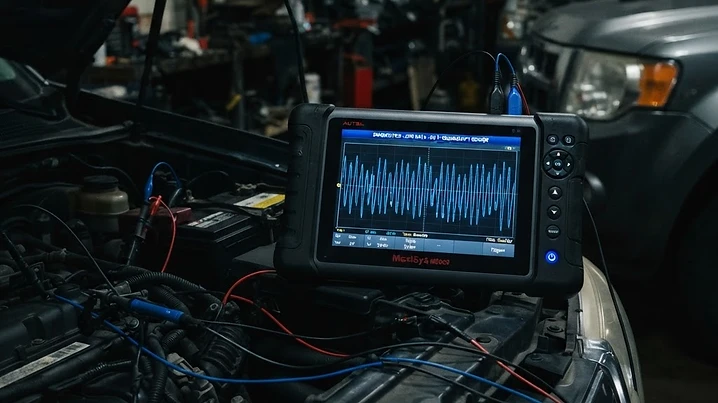
A client arrived via tow truck: the car simply stalled at a traffic light and showed no signs of life afterward. The starter cranks well, but the engine won't even catch. The ECU memory contained error code P0335 — a classic signal that the ECU has lost connection with the crankshaft. For an engine, the crankshaft position sensor (CKP) is like a pulse for a human. If the control unit cannot see the position of the pistons, it will not issue a command for spark or fuel injection. The car turns into a pile of scrap metal because the 'brains' simply don't know exactly when to ignite the mixture. ## How we looked for the cause Our first step is not to rush and replace the sensor, but to inspect the wiring. Often, the problem lies not in the sensor itself, but in corroded connectors or frayed wires lying right on the hot engine block. In this case, we connected an oscilloscope — it is like an EKG for a doctor. We saw that the signal from the sensor was intermittent, with 'gaps.' This immediately ruled out a wiring break and pointed to an internal malfunction of the sensor itself or issues with the reluctor wheel. ## What we check during diagnostics With this type of error, we always go through our checklist: 1. Integrity of the connector and wiring to the ECU. 2. Presence of metal filings on the sensor itself (these distort the magnetic field). 3. Condition of the timing teeth (reluctor wheel) on the crankshaft — sometimes teeth break off or the disc deforms. 4. Resistance of the sensor winding (if it is of the inductive type). In our case, the sensor turned out to be 'tired' from overheating: the plastic housing had deformed slightly, and a micro-break was occurring inside the winding, which only manifested when the engine got hot. ## Common repair mistakes The most frequent mistake is replacing the sensor with a cheap aftermarket part without checking the mounting seat. If the sensor is slightly further away or closer to the disc than required, the signal will be weak, and the car will stall once it warms up. It is also important to clean the mounting seat of dirt and old oil; otherwise, the new sensor will sit at an angle. If the problem persists after replacement, you may need computer diagnostics for adaptation or to check synchronization parameters in real-time. ## Practical conclusion If your car has started stalling for no apparent reason or refuses to start 'when hot,' don't rush to replace everything at once. A problem with the CKP sensor often manifests exactly when the engine temperature changes. If diagnostics confirm the sensor is faulty, use only high-quality parts — this component is critical for engine operation. In complex cases where the problem lies within the control unit itself, you may require ECU repair, but this happens much less frequently than a simple sensor failure.
Read also
Проверка реального пробега при покупке автомобиля: честно о том, что возможно
Скрученный пробег — одна из самых частых проблем при покупке авто с рук. Рассказываем, как проверяется реальный пробег по электронике, почему не на всех марках это просто и что стоит проверить до оплаты.
Video: A look at our work at AUTOLAB
We filmed a raw, unedited look at a day in the AUTOLAB workshop, showing exactly how our diagnostics and ECU tuning processes happen behind the scenes.
Car won't start: the story of a dead ECU
A client brought in a car that suddenly stopped responding to the key. We explain why sometimes the problem isn't mechanical, but rather in the car's brain.