
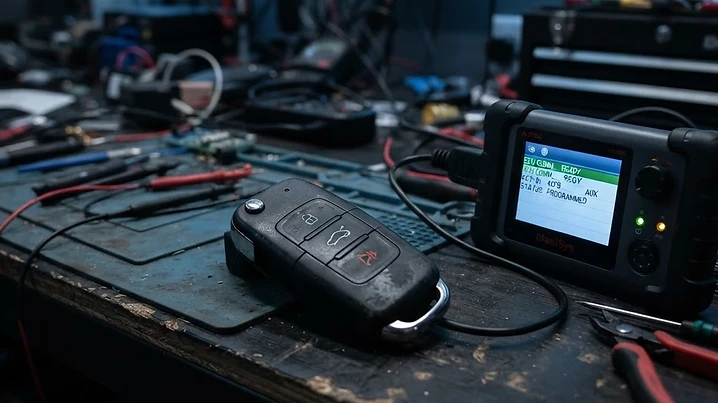
The immobilizer is your car's electronic 'guard'. Hidden inside the key is a tiny chip with a unique code, and there is an antenna installed in the car that reads this code. If the 'guard' does not recognize the code, it blocks the fuel supply or the starter. It's as if you were trying to open your apartment door with the wrong key: the lock simply won't turn. When the system fails, the car becomes immobile, even if the battery is charged and the starter is in perfect working order. ## Typical situations and symptoms Most often, owners face three scenarios. The first is complete loss of keys. The second is that the key is present, but the car does not respond to it: the key symbol indicator on the dashboard either flashes or does not light up at all. The third is that after replacing a dead battery or attempting a jump-start, the synchronization between the Engine Control Unit (ECU) and the immobilizer has been lost. In such cases, computer diagnostics is the first thing you need to do to understand exactly where the signal is being 'lost'. ## Why this happens The causes are divided into mechanical and software issues. The former includes physical wear of the immobilizer antenna or damage to the chip inside the key after dropping it. The latter includes software glitches in the control unit memory. Sometimes the problem lies in the wiring: oxidized contacts or a frayed wire create interference, causing the key code to arrive at the unit 'corrupted'. If you encounter this, ECU repair or reflashing may be required. ## What we check in the service shop A diagnostician starts by checking the power supply and the integrity of the wiring. Then, using a scanner, we check if the control unit sees a request from the key. If the key is 'dead', we check it on special equipment – a programmer. If the problem is in the unit, we analyze the data in its memory. In complex cases, where the control unit cannot be repaired, we carry out ECU replacement followed by linking all keys to the new system. ## Common owner mistakes The biggest mistake is trying to 'trick' the system with makeshift tools or buying used units from a scrapyard without preparing them beforehand. A unit from another car won't just work: it doesn't 'know' your key and lacks the necessary data to start the engine. Attempts to program keys with cheap Chinese scanners often end up with the car entering 'security mode' permanently, failing to respond even to the original keys. In such situations, ECU cloning is the only way to bring the car back to life without buying expensive new components. ## Practical conclusion If the car won't start and the immobilizer icon is lit on the dashboard, do not try to 'program' the key yourself or swap units at random. Start with professional diagnostics. Often the problem is solved by a simple re-linking of the key or restoring a contact in the wiring, which is significantly cheaper than replacing electronics.
Read also
Проверка реального пробега при покупке автомобиля: честно о том, что возможно
Скрученный пробег — одна из самых частых проблем при покупке авто с рук. Рассказываем, как проверяется реальный пробег по электронике, почему не на всех марках это просто и что стоит проверить до оплаты.
Video: A look at our work at AUTOLAB
We filmed a raw, unedited look at a day in the AUTOLAB workshop, showing exactly how our diagnostics and ECU tuning processes happen behind the scenes.
Car won't start: the story of a dead ECU
A client brought in a car that suddenly stopped responding to the key. We explain why sometimes the problem isn't mechanical, but rather in the car's brain.