
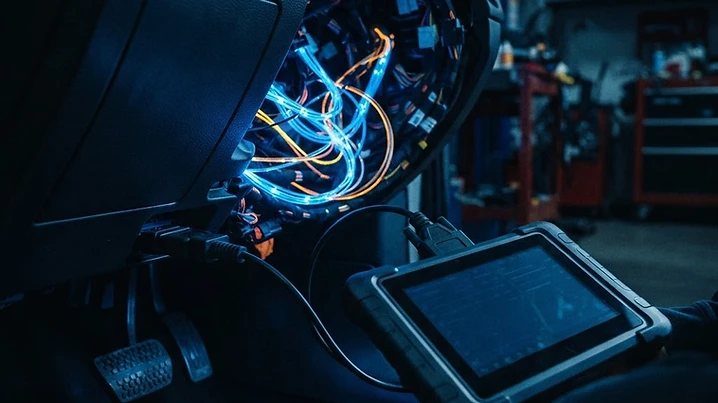
Think back to home internet twenty years ago: to load a single photo, a dial-up modem squeaked and screeched over the telephone line for several minutes. For a long time, control units inside cars communicated in a very similar fashion. The familiar CAN (Controller Area Network) bus reliably did its job for decades, relaying straightforward commands like "turn on the headlights" or "increase fuel delivery."
However, modern cars are packed with dozens of cameras, radar cruise control units, gigabytes of dashboard graphics, and complex driver-assist systems. The old "telephone line" has become completely congested. Classic CAN is now making way for a new generation of communication networks: CAN-FD and Automotive Ethernet. Let’s break down what this means for your car and for you as an owner in plain English.
Automotive Buses: What Are They in Everyday Terms?
Every car houses dozens of tiny computers (electronic control units, or ECUs): the engine control unit, ABS, climate control, airbags, and more. If a dedicated wire had to run between every single module, the wiring harness would weigh hundreds of kilograms.
To solve this, engineers connected the control units using a shared "data bus." It functions much like a team chat in a messaging app. Every module is hooked up to the same channel and listens for updates: the brake module sends a message saying "wheel slip detected," the engine ECU immediately rolls back the throttle, and the transmission holds the gear. Classic CAN worked like a charm as long as the volume of messages stayed relatively small.
CAN-FD: Fast Delivery for Critical Commands
The suffix FD stands for Flexible Data-rate. If traditional CAN is a narrow country road where traffic crawls at 500 kilobits per second, CAN-FD expands that road into a high-speed multi-lane highway (reaching 5–8 megabits per second).
Instead of a meager 8 bytes of data per transmission, a module can now send up to 64 bytes in a single burst. As a result, braking systems, power steering, and adaptive suspensions swap mission-critical data with almost zero latency. For the driver, this translates into lightning-fast reactions from safety systems at the earliest sign of a skid or obstacle.
Automotive Ethernet: Fiber-Optic Speeds Inside Your Car
If CAN-FD is a high-speed lane for telegrams, Automotive Ethernet is a full-fledged high-speed broadband network built right into the vehicle's body, just like the wired internet in your living room. Speeds here are measured in gigabits per second.
Why does a car need this level of performance?
- Surround-View Cameras: High-definition video streams are fed to the head unit in real time without lag or artifacting.
- Over-the-Air (OTA) Firmware Updates: Multimedia and navigation firmware files are dozens of gigabytes in size. Flashing them over legacy CAN would take days, whereas Ethernet and the DoIP (Diagnostics over IP) protocol get it done in a matter of minutes.
- Autopilots and LiDAR: Onboard processors ingest massive point clouds detailing the surroundings, instantly detecting and processing obstacles.
Why Inexpensive Garage Scanners Are Powerless
The key practical takeaway comes down to diagnostics and maintenance. Many drivers keep a cheap ELM327 Bluetooth dongle in the glovebox: plug it into the OBD-II port, pull error codes via a phone app, and you're good to go.
With newer cars (starting roughly around 2020–2022 for most European and Asian makes), this trick simply no longer works. An older scanner physically cannot decode a CAN-FD signal: to the adapter, it looks like meaningless high-frequency static on the wires. What's more, the diagnostic port in many modern vehicles has fully transitioned to the internet protocol standard (DoIP).
Plugging an outdated tool into a recent vehicle usually returns a communication fault: the app claims that "ignition is off" or "ECU not responding," even though the car is in perfect working order.
Practical Takeaways for Car Owners
Automotive electronics have permanently entered the era of high speeds and advanced networking:
- Don't rush to swap parts blindly if a cheap generic scanner fails to detect a control module—chances are, the tool simply lacks hardware support for CAN-FD or DoIP.
- Thorough computer diagnostics on newer models require up-to-date professional service equipment that supports the latest bus protocols and current software databases.
- Flashing and updating software on modern vehicles is now significantly faster and safer thanks to high-bandwidth interfaces. When you need in-depth system testing or module configuration, it's best to book a diagnostic appointment with specialists equipped with dedicated diagnostic interfaces.
Read also
What Is Electronic System Adaptation and Why Repair Isn't Done Without It
After replacing a sensor or component, a car sometimes behaves strangely. We explain in plain English what the adaptation procedure is and why the ECU cannot read the mechanic's mind.
Stage 1 Chip Tuning: What Really Changes in the ECU Software
What actually changes in the engine software, how much performance it delivers, and why it is safer than it seems. Breaking it down with zero marketing fluff.