
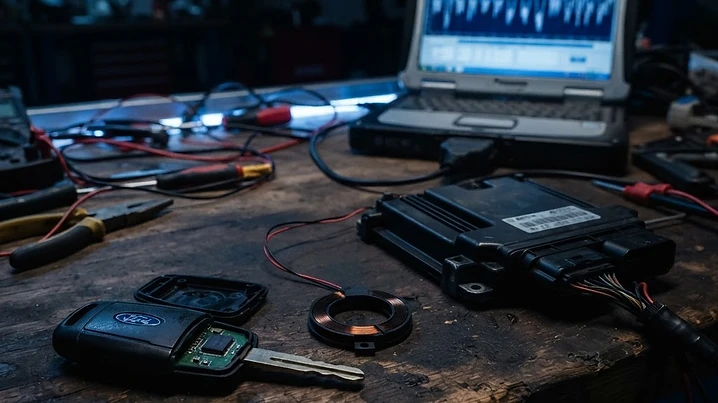
A modern car key is no longer just a notched piece of metal. Today, it serves as an advanced digital security pass. When you insert the key into the ignition or press the Start button, a split-second conversation unfolds behind the scenes: the onboard electronics query the key, verify the cipher, and decide whether to let the engine roar to life or leave you stranded in the parking lot. The immobilizer system is in charge of this security gate.
Let’s break down in simple terms how this system works, the typical situations car owners run into, and why heading to a regular key-cutting booth often leads to disappointment.
How It Works: The Nightclub Analogy
Picture an exclusive nightclub with strict security at the door. The mechanical key blade is merely the exterior door handle: you can turn it, but nobody is letting you past the entrance. Hidden inside the key is a transponder (a microchip), and around the ignition barrel or behind the start button sits a reader antenna.
When you turn the ignition on, the antenna sends a request: "State your password." The chip inside the key instantly replies with a secret code. If the bouncer (the immobilizer module) and the general manager (the engine control unit, ECU) agree that the passcode checks out, the system greenlights fuel supply and ignition spark. If the code doesn’t match or the key has no programmed chip at all, the engine either won't crank at all or fires up for a second and a half before stalling immediately, leaving a flashing key icon on the dashboard.
Scenario 1: Key Lost (or Only One Key Left)
The most frequent mistake drivers make is putting off getting a spare key while they still hold one working original.
Making a duplicate when you still have a functioning key is a relatively quick and trouble-free procedure. A technician reads the necessary data from the car via the diagnostic port, takes a fresh transponder blank, and completes key programming into the car's memory.
However, if you suffer all keys lost, the situation changes drastically. The vehicle is locked up tight, and the control modules refuse entry to everyone. In this scenario, technicians must either pick the locks or remove electronic control units onto a workbench, desolder memory chips, or connect specialized programmers straight to the microcontroller to extract the secret PIN code and teach in a new chip from scratch. That takes significantly more time and causes unnecessary stress.
Tip: If you're down to a single key, make a spare in advance. It will save you from expensive towing fees and prolonged downtime.
Scenario 2: Replacing an Electronic Module (ECU or Instrument Cluster)
Consider this common repair: a vehicle breaks down, and the shop condemns the engine control unit, body control module, or digital instrument cluster. The owner grabs a used replacement from a salvage yard, plugs it into the car, turns the key, and gets complete silence. The starter might even crank, but the engine remains lifeless. Why?
Because a modern vehicle's electronic modules depend on a "digital handshake." The donor unit still stores security codes from its previous vehicle and treats your current keys as foreign intruders. Simply swapping the connectors is never enough. A used module must be reset (returned to its factory "virgin" state) and adapted to your specific vehicle, synchronizing the immobilizer, ECU, and keys into a unified ecosystem.
Scenario 3: Lost Key Sync or a Dead Battery
Drivers often confuse two entirely different components: the remote control battery and the immobilizer transponder chip.
- The battery only powers the lock/unlock buttons on the remote (the radio frequency transmitter).
- The immobilizer chip itself in classic flip keys is completely passive; it is powered by the electromagnetic field generated by the ignition ring antenna, much like a contactless payment card. Therefore, even if your remote battery is bone dry, a healthy chip will still start the vehicle.
However, in modern push-to-start cars with Keyless entry, a drained key fob battery can indeed prevent the vehicle from starting. Such cars always feature an emergency procedure: pressing the tip of the smart key directly against the start button or against a marked induction spot on the steering column.
If the key is physically intact, the battery is brand new, yet the immobilizer warning light keeps flashing, the culprit might be a lost synchronization caused by a deep car battery discharge, an internal chip crack from being dropped onto asphalt, or corrosion inside the immobilizer antenna connector.
Practical Takeaway
A car key is the digital passport to your vehicle. To avoid unexpected headaches:
- Never rely on having only one working key—get a duplicate made beforehand.
- Keep in mind that simple key-cutting will not start the engine; the transponder chip requires proper software pairing with the onboard modules.
- Whenever swapping electronic control units, be prepared for diagnostic programming and adaptation, or the car's security system will shut down the start sequence.
Read also
Immobilizer Not Recognizing Key: Why It Happens
Car not recognizing the key: a breakdown of common causes—from a dead key fob battery to desynchronized control modules.
Car Stalls When Hot: A Real-World Case of Tracking Down a Hidden Fault
The engine starts up perfectly, but as soon as it warms up, the car suddenly dies right while driving. We break down a real diagnostic case from our workshop.