
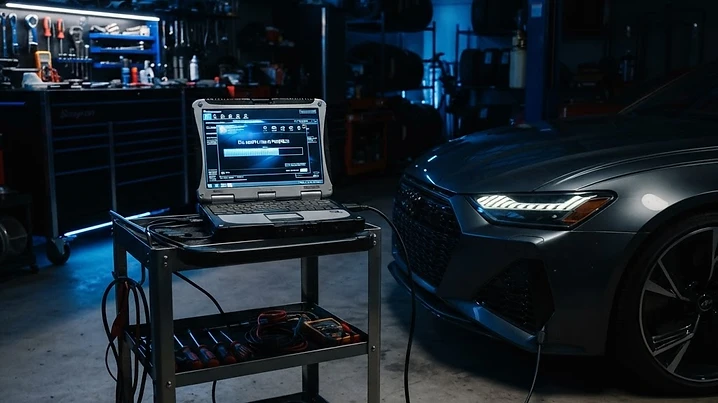
Every modern car owner has encountered this at least once: a brand-new part was installed at the service center—such as a throttle body, an EGR valve, or a steering angle sensor—you drive off, and the car jerks, misfires, or idles abnormally high. An anxious thought immediately crosses your mind: did they install a defective part? Most often, it's not a defect at all. The car was simply never taught how to work with the new component; in other words, the adaptation procedure was not performed.
The Car's Brain and Its Habits
The electronic control unit (ECU) is the primary brain of the vehicle. It constantly monitors hundreds of parameters and manages complex processes. However, car parts do not wear out overnight: metal surfaces wear in, carbon deposits coat passage walls, and rubber loses its elasticity.
To keep the engine running smoothly even with aging components, the control unit gradually adjusts to their actual condition. Imagine you have worn a broken-in pair of slippers for years and grown accustomed to stepping in a very specific way. In the exact same way, the ECU remembers: "Due to dirt build-up, this flap rests slightly more open than normal, which means I need to inject slightly less fuel than the baseline standard." These accumulated adjustments are known as adaptation trims or values.
What Happens When a Part Is Replaced
When a mechanic removes a worn component and installs a spotless new part, a new life begins for the mechanical hardware. But the electronic brain doesn't know this! Its memory still holds old habits tailored to the worn-out component. It keeps managing the completely new part based on a pattern developed over years of driving.
This is like suddenly putting a person in rigid ice skates instead of their familiar old sneakers without giving them a heads-up: they will try to walk normally and inevitably stumble. In the same way, the engine begins to "stumble," idle too high, or trigger a Check Engine light.
How the Adaptation Procedure Works
Adaptation (or relearn/initialization) is a software process where a diagnostic technician uses a specialized scanner to clear outdated control unit habits and initiate a baseline calibration procedure. Professional computer diagnostics helps pinpoint parameter mismatches and launch the required service routines.
During this process, the control unit and the mechanism literally get reacquainted:
- Finding end stops. For instance, the electronics will close the throttle body all the way, swing it fully open, and record these physical limits into memory.
- Zero-point calibration. When adapting a steering rack, the system records the precise position where the wheels are pointing "dead straight."
- Drive-cycle relearn. Certain components, such as automated manual transmissions or air-fuel ratio sensors, require a specific road test drive cycle at certain speeds so the unit can smoothly build a fresh parameter table on its own.
Why Adaptation Doesn't Always Happen on Its Own
There is a common myth that simply disconnecting the battery overnight or driving several dozen miles will allow the car to learn everything by itself. For some basic systems, this is partially true: the ECU can indeed gradually adjust fuel trims during a steady, prolonged cruise.
However, modern vehicles are engineered much more strictly. Built-in safety algorithms prevent the control unit from making sudden, drastic parameter jumps for safety reasons. If the discrepancy between expected values and the new component's feedback is too large, the control unit won't attempt to relearn—it will simply assume the part is broken, activate limp mode, and restrict engine power.
Summary for Car Owners
Physically replacing a sensor or actuator under the hood is only half the repair. The second, equally crucial half is synchronizing the new hardware with the software. If your car's behavior raises questions after a workshop visit, ask the technician if an adaptation procedure was performed for the replaced part. In most cases, proper electronic relearning immediately restores factory-level smoothness and responsiveness, and you can book a service as soon as mechanical work is complete.
Read also
Stage 1 Chip Tuning: What Really Changes in the ECU Software
What actually changes in the engine software, how much performance it delivers, and why it is safer than it seems. Breaking it down with zero marketing fluff.
Immobilizer Not Recognizing Key: Why It Happens
Car not recognizing the key: a breakdown of common causes—from a dead key fob battery to desynchronized control modules.